
Field notes · Durability
Downhill running wrecks quads: how to train for descents
Darren Ware, ultra running coach · · updated · 5 minute read
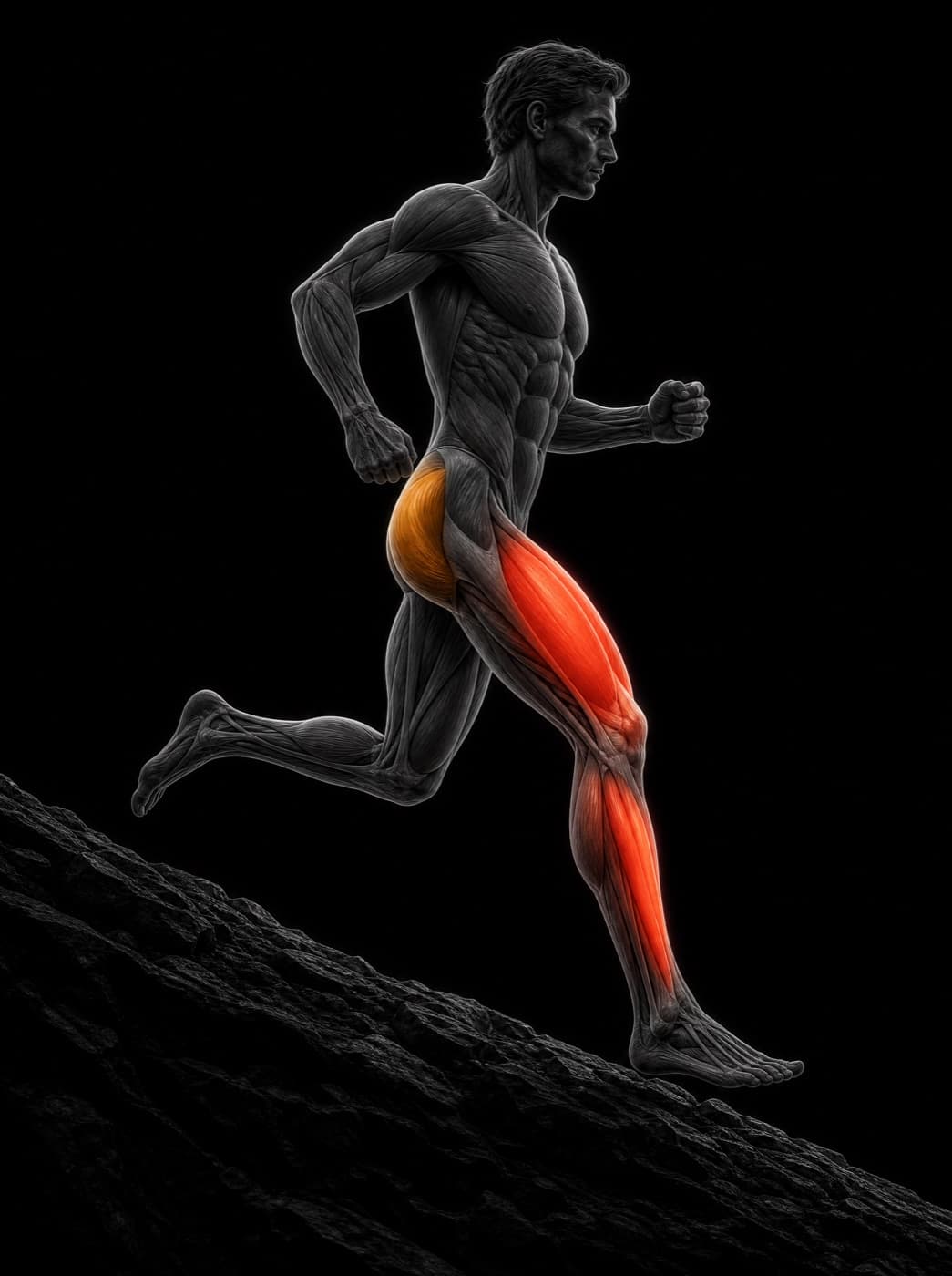
Climbs hurt, but descents destroy. On a steep downhill your quads work as brakes: they lengthen while producing force, on every single step. That lengthening-under-load work, eccentric work, creates substantial muscle damage and soreness, and it is why runners who felt strong at the summit are reduced to a sideways shuffle two hours later.
What the load actually looks like
Notice the shin muscle high on that list. It controls the foot on the way down. When it fades, your foot slaps, your rhythm breaks, and your ankles start gambling on every rock.
The repeated-bout effect is your best friend
Here is the good news: a hard enough downhill session gives partial, temporary protection against the next similar one. Do a hard descent and the soreness after the following one drops sharply. The protection is not complete, it fades over weeks to months, and it is specific to that kind of load, but it is real. This is the cheapest adaptation in ultra running, and most people never train it because descents feel free on the day.
How I build descent tolerance
- Start early and start gentle. Short, moderate descents months out, not heroic drops three weeks before a race.
- Run them fresh first. Learn braking mechanics before you practise them tired.
- Heavy strength work in the gym. Squats and split squats build the same tissue the descents attack.
- Later in a block: descents on tired legs, deliberately, because that's the race.
- Poles for the steep stuff if your race allows them: they take a measurable share of load off the legs on the climbs, and lower soreness and muscle damage after descents.
What I watch
- Downhill pace late in long runs, compared with the same descents fresh.
- How much speed disappears after sustained climbing.
- Whether form and control survive once the legs are tired, or the braking gets ragged.
If the fade in a hilly run is braking cost rather than engine cost, the plan changes: more of the gym work above, and descents placed deliberately on tired legs. When descent tolerance improves, athletes are much better able to preserve their running late in hilly races.
Descending is the tissue that decides UTMB and the Dragon's Back, and both guides say how I would train it. The lifting that protects the quads is in the strength note.
Evidence level: eccentric muscle damage from downhill running and the repeated-bout protective effect are both well established. The training progression is coaching practice built on that evidence.
Want this applied to your race?
Tell me what you're training for and where things break down.