




Ultra coaching for runners 40+
Build legs
that last.
Personal ultra-running coaching built around your life and your race. Running, strength, fuelling and recovery, with clear guidance from where you are now to race day.
- RunningSmarter training for longer races
- StrengthA stronger, more resilient you
- FuellingReal-world nutrition that works
- RecoveryStay healthy and keep doing what you love
The coaching approach
I manage your
entire preparation.
Your race asks more of you than just the distance in training. I bring everything together: training, strength, fuelling, recovery and your real life, so you can arrive at the start line ready.
Talk to DarrenPersonalised plans
Built around your life, goals and experience.
Holistic coaching
Running, strength, fuelling and recovery working together.
Ongoing support
Regular feedback, adjustments and accountability.
Real progress
Build confidence, consistency and long-term performance.
Darren Ware, founder and coach
A lifetime of running.
A personal approach to coaching.

Darren Ware, founder and coach
Darren Ware, founder and coach
A lifetime of running.
A personal approach to coaching.
I’ve been running since I was ten. As a teenager, I competed for my county as a sprinter. Later came marathons, including New York and London, followed by ultramarathons. In 2003, I completed the Marathon des Sables. In 2027, aged 52, I’m going back.
That background shapes how I coach, but your preparation starts with you: your running experience, your race and the time you have to train.
I bring your running, strength work, fuelling, recovery and race preparation into one plan. I review your completed sessions alongside your feedback, explain the adjustments and make changes when needed. How you feel matters as much as the numbers on your watch.
You work directly with me throughout. We’ll look at how you’re handling the training, what needs attention and how to fit the work around the rest of your life.
Talk to DarrenWhat private coaching includes
Coaching, not a PDF.
Your check-in takes a few minutes.My review does not.
How often
I review every completed week. Your next two weeks remain visible, but I adjust the training whenever your response, recovery, schedule or race preparation requires it.
Scope
I provide running coaching, not injury diagnosis or rehabilitation. If pain or a medical concern needs assessment, I will ask you to seek advice from an appropriate qualified professional before we continue the relevant training.
- 01A 90-minute onboarding and complete review of training, racing, injury history, available time and target event
- 02A race-specific preparation strategy
- 03Individually prescribed running and strength training
- 04A written coach assessment every week
- 05Training adjusted whenever the evidence or your response warrants it
- 06A scheduled coach call at least every fortnight
- 07Direct messaging with responses within one working day
- 08Long-run progression and durability review
- 09Fuelling, hydration and gut-training strategy
- 10Terrain, climbing, descending, pack and heat preparation
- 11A complete pre-race execution plan
- 12Post-race analysis
Real examples from the process
See how I coach.
1. Plan
A structured plan built around your goals, your life and your durability. You see every session and how each one went.
5 mi · 1h 04m · avg 129 · 33% above capView run →
2. Review
I look at what you've done, how you responded and where you're trending.
3 of 4 easy runs this week breached the 131 bpm cap (average over 133, or more than a fifth of the run above it). The cap is a ceiling. Slow down until it holds.
This week
3. Adjust
I say what's working, what's limiting you, and what changes next week.
Solid week completed, 27 of 28 planned miles, but cap breaches persist for a third straight week, that is the priority now.
- Slow easy runs deliberately to 5-10bpm under the 126 cap, use a run-walk approach on flatter sections if needed to break the breach pattern.
- Hold next week's volume flat rather than advancing, given three straight weeks of cap breaches under the durability-first gate.
- Clarify the back niggle status directly this week and update injury notes to match what you're actually feeling.
- Keep long run fuelling at 40g/h or above as volume rises.
28 Sept 2026 · feel 5/5 · applied · 5 flags
4. Progress
We track the signals that matter, like your aerobic pace at the same heart rate, week by week.
Aerobic base
The athlete is holding their easy pace at the same aerobic effort. Based on limited comparable data so far.
One week would change the verdict on its own, so the trend is called flat until more comparable weeks are in.
Long-run efficiency on the last long run (27 Sept): Their aerobic efficiency stayed stable through the run. (drift 2.2%)
The same process on my own training, run by run: My Personal Log
Private 1:1 coaching
Private ultra‑running coaching
I manage your entire preparation.
The running plan is one part of it.
Places are limited.
Pricing is covered on your call.
Initial three-month block ·
No cost to apply
Subject to the 30-day mutual-fit option below.
Your preparation,
brought together.
- Running & strengthTraining built around your life and your race.
- Fuelling & recoveryPractical guidance throughout your preparation.
- Weekly review & adjustmentsYour training and feedback reviewed personally.
- Direct contact with DarrenOne coach throughout. Nothing delegated.
Every application reviewed personally by me.
Within the first 30 coaching days, either of us can end the remaining commitment.
Coaching already delivered is not automatically refunded.
Payments & the initial three-month block
Three monthly payments, on dates written into your agreement before anything is charged. No setup fee, and nothing charged for a fourth month inside the initial block.
Three months is the initial coaching commitment. It is not a promise to get you to an ultra in three months: which event, and how long the build takes, depend on where you start and how you progress.
30-day mutual fit
During the first 30 coaching days, counted from your agreed start date, either of us can end the remaining commitment. You give notice by email to coach@darrenware.com. Coaching already delivered is not refunded automatically. This is separate from your statutory cancellation rights, which your agreement sets out.
Your start date & ongoing coaching
There is no shared start date or deadline. Each athlete's start date, onboarding and payment dates are agreed one to one, and written down before payment.
Coaching beyond the first block continues only under an active coaching agreement.
Your preparation changes when you do.
How I use your training data
Human coaching.
Informed by your data.
Your training tells me what you did.
Your feedback tells me how it felt.
I review both and adjust your preparation around your progress, recovery and life.
- LoadTraining load and volume.
- How much you're doing, and how consistently you're building.
- ResponseHeart rate and effort.
- How your body responds to the work, alongside how it feels.
- DurabilityWhat changes later in a run.
- Patterns in pace and effort, considered alongside terrain and fuelling.
- RecoveryRecovery between sessions.
- Sleep, fatigue and your feedback help guide what comes next.
We start conservatively and build the picture as your training history grows.
Your data is evidence, not a verdict.
The real limiters
I train what happens after
"fit enough".
Many runners are aerobically fit enough. What lets them down is the ability to keep producing: pace and output that deteriorate late in long runs and races, while the heart rate says everything is fine.
Hours into an event, performance can start disappearing for very different reasons.
Fitness gets you to the start. How you hold together under fatigue helps decide what happens next.
- EarlyEverything is working; effort and movement remain controlled.
- As fatigue buildsMuscular force and economy can begin to change.
- Deep into the eventTissue tolerance, fuelling and pacing become increasingly important.
- Late raceThe combined effect of preparation and execution becomes visible.
- Muscular fatigue
- Your cardiovascular system can still feel capable while your legs lose the ability to produce force.
- Tissue tolerance
- Feet, calves, quads, tendons and connective tissue have to tolerate thousands of repeated impacts.
- Fuelling
- You need to absorb carbohydrate and fluid for hours, not just know what you should eat.
- Heat and environment
- Temperature, terrain, altitude, weather and equipment can completely change the demand of an event.
- Pacing
- A race can be compromised hours before you realise you've gone too hard.
How I coach you
Measure. Understand.
Adjust. Repeat.
01 / Assessment
We start with your race, your training history and where your performance currently breaks down. I read your data before I write a single session.
AssessedThis weekHeldHR cap discipline0 of 2easy runs breached 126 bpmTo reviewLate-run efficiency6.3%changed on 27 Aug long runSteadyRecoverysteadyRHR 55.4 · HRV 42 · sleep 7.4 hSyncedLast week47km synced · Mon to SunWhat this week means02 / Plan
I build your training around your life: your days, your long-run history, your strength work, your race.
ApprovedThis week · 31 Aug 2026Open- MonEasy run8 km
- TueStrength (heavy lower)·
- WedEasy run10 km
- ThuEasy run9 km
- FriStrength (upper/core)·
- SatRest
- SunLong run20 km
Drag a session to another day, or use the arrows. Days swap. Distances and session types stay as planned.03 / Monitor
Your watch syncs, I read the response: load, heart-rate discipline, late-run fade, recovery. Every week.
ReviewedDurabilityPattern forming3 comparable runs2h 10m to 2h 30mAcross your last 3 comparable long runs, efficiency has started to fall away somewhere in this window. Latest run shown below.
Latest: 25.7 km in 3h 46m on 27 Aug 2026 · one run on its own is not a trend
Comparable runs3used for this rangeTerrain299 m up296 m downRead as a pattern across comparable runs, never off one. Terrain, conditions, pacing, fuelling and sleep all move this, so Darren reads it alongside them and decides.
How Durability works04 / Adjust
When the evidence says change, I change the training. Miss a week and it adapts; progress faster and it responds. The objective is simple:
Arrive at race day able to keep producing when everybody else is starting to fade.
AdjustedNext week · 7 Sept 2026 · 49 kmProvisional- MonStrength (upper/core)·
- TueEasy run10 km
- WedStrength (heavy lower)·
- ThuAerobic run13 km
- FriRest
- SatRest
- SunLong run26 km
Your recent training supports a small step up: 49 km this week. Long run 26 km. The long run builds from what you have run recently.
What gets trained
Build the complete ultra runner.
Aerobic control
Build the aerobic capacity to keep easy running genuinely easy and sustainable.
Muscular durability
Develop the ability to maintain movement quality and output as fatigue accumulates.
Strength
Build stronger legs and improve your ability to tolerate repeated loading.
Race specificity
Prepare for the terrain, climbing, descending, duration, pack and conditions you will actually face.
Fuel and heat
Practise carbohydrate intake, hydration, sodium strategy and environmental preparation before race day.
Recovery and load
Progress training without continually digging a hole you can't recover from.
The objective isn't one heroic training week. It's months of repeatable work.
Understand what changes as fatigue accumulates
What actually fades
when the miles build up.
Slide the gradient. The load moves: quads take the braking on descents, glutes and calves drive the climbs. This is the physiology behind the fade, and it is trainable. I train all of it, because your race has all of it.


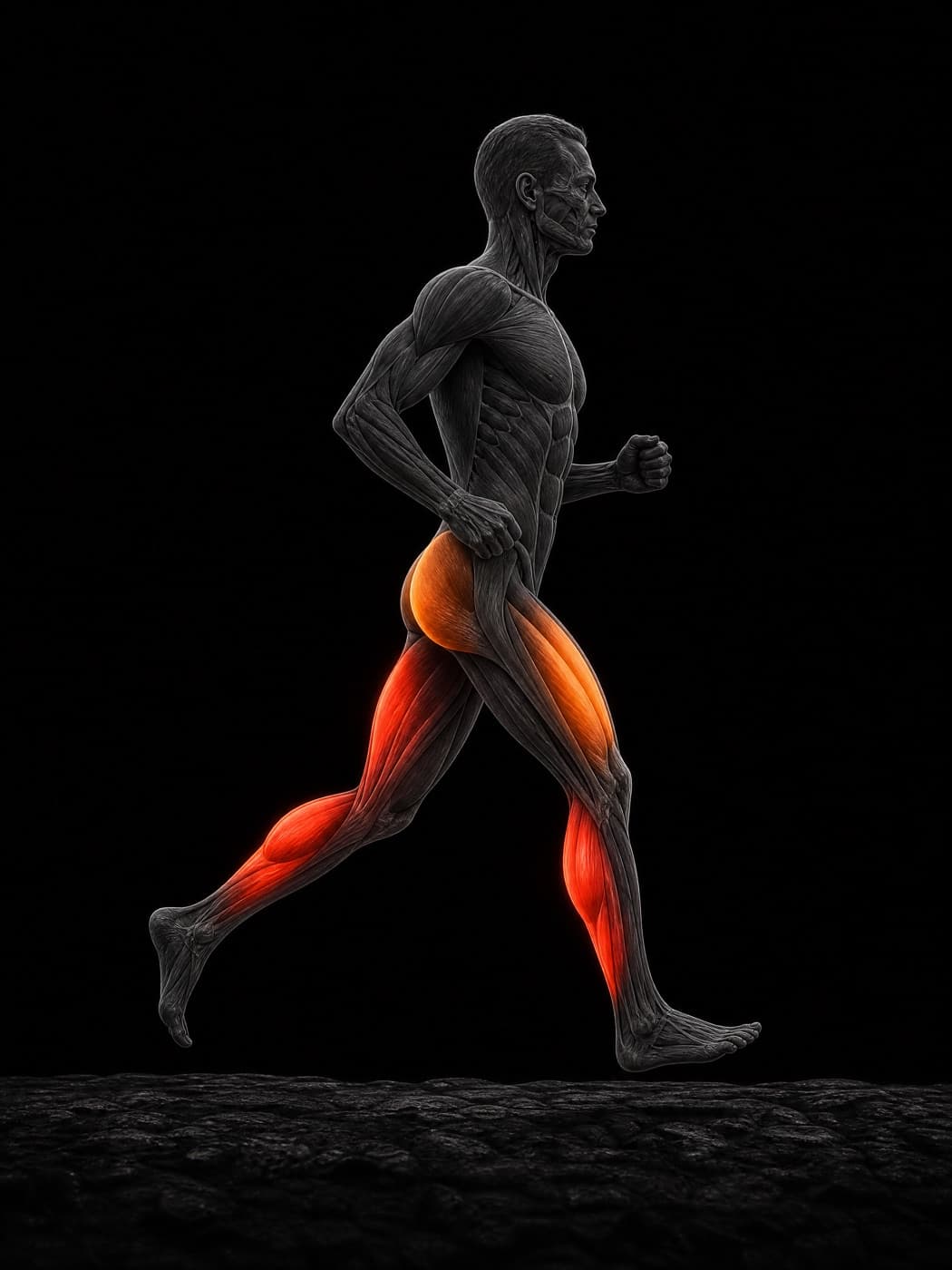
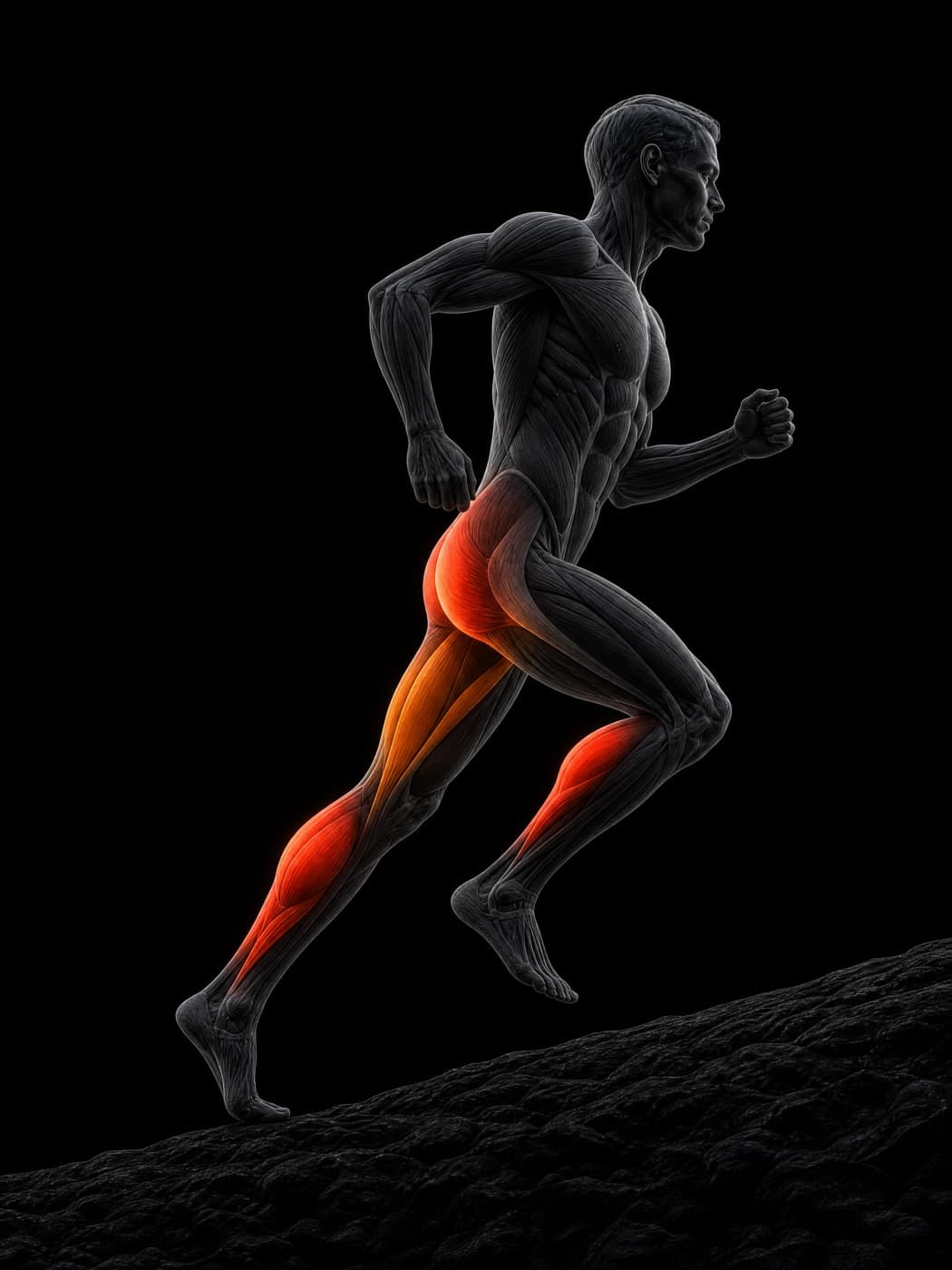
 FLAT · 0%
MUSCLE LOAD
Everything shares the work: calves and hamstrings drive, glutes stabilise. The ground where easy volume gets built.
Relative activation pattern drawn from EMG research on graded running (uphill: vastus group +23%, soleus +14% at a 10% grade; downhill: eccentric quadriceps braking). An illustration of the pattern, not a measurement of you. ECC marks eccentric, lengthening-under-load work.
Coached by Darren Ware
Training is only one part of endurance performance.
Durability is the coaching and training system I built around one question: what helps endurance athletes keep moving for longer.
- Training
- Fuelling
- Hydration
- Heat
- Recovery
- Testing
The same principle applies to everything I build:
Solve the problem first.
Test it in the real world.
Apply for private coaching
Build legs that last.
Tell me the race.
Tell me the date.
Tell me what you're preparing for, where you are now and what normally starts going wrong when the distance gets serious. I'll review it personally and come back to you within two working days.
Training for an ultra?
Built around your race.
Durability can be used to prepare for mountain ultras, trail ultras, desert races, backyard ultras and multi-day endurance events.
- Marathon des Sables training →
- UTMB training →
- Western States 100 training →
- Hardrock 100 training →
- Badwater 135 training →
- Spartathlon training →
- Comrades Marathon training →
- Dragon's Back Race training →
- Cape Wrath Ultra training
- Montane Spine Race training →
- Lakeland 100 training →
- Arc of Attrition training →
- South Downs Way 100 training →
- West Highland Way Race training →
- Centurion Thames Path 100 training →
- Grand Union Canal Race training →
- Leadville Trail 100 training →
- Tor des Géants training →
- Ultra-Trail Cape Town training →
- Cocodona 250 training →
Don't see your race?
Durability isn't built around a list of races. It's built around the demands of yours.
FAQ
Questions, answered plainly.
- What is Durability?
- Private ultra coaching for runners aged 40 and over. It combines aerobic control, muscular durability, strength, race specificity, fuelling and heat preparation, and recovery and load management. A training platform reads what you actually completed; it organises the evidence and proposes options, and I decide what changes.
- Is it only for the Marathon des Sables?
- No. Durability is built for ultramarathons, mountain races, multi-day events, desert races and long endurance challenges. The MdS is the founder's proving ground in 2027, not the programme.
- How is it different from a training plan?
- A plan is written once. I review every completed week. Your next two weeks remain visible, but I adjust the training whenever your response, recovery, schedule or race preparation requires it. Missed training is never repaid, over-training is not rewarded, and when there is not enough data I start you conservatively and say so.
- Who makes the decisions?
- I do. The platform reads your watch data, heart-rate discipline, late-run efficiency, training load and recovery, organises the evidence and proposes options. Every change to your training is mine, and I approve it before you see it. No score writes your plan or decides whether you are ready.
- What data do you need?
- A Garmin or Coros watch synced through Intervals.icu. Heart rate on easy runs matters most. Runs without the watch can be added by hand.
- What does it cost?
- Places are limited, and I cover pricing on your call once I've read your application and know what you need. Coaching starts with an initial three-month block, paid as three monthly instalments on dates written into your agreement. Nothing is charged until we have agreed your start date and you have the written agreement.
- Is three months enough to get me to an ultra?
- Three months is the initial coaching commitment, not a promise. How long the build takes, and which event makes sense, depend on where you start and how you progress. Support beyond the first block continues only under an active coaching agreement.
- What is the 30-day mutual-fit period?
- During the first 30 coaching days, counted from your agreed start date, either of us can end the remaining commitment. You give notice by email to coach@darrenware.com. Coaching already delivered is not refunded automatically. This is a voluntary fit period and is separate from your statutory cancellation rights, which the agreement sets out.
- Is 40 too old to start ultra running?
- No. Peak ultra performance sits in the late thirties to mid forties and strong results continue past 50. Training age and consistency matter more than birth year. A new runner at 42 needs a longer base than a 52 year old with 25 years of running.
- How does ultra training change after 40?
- Keep the aerobic volume you can sustain, keep one hard session a week, make everything else easy, lift twice a week, eat more protein, sleep more, and leave more room between demanding days. Do not simply train less.
- What is the safest way to build long runs?
- Keep the planned long run at or under about 110% of the longest run you completed in the last 30 days. In a 2025 study of 5,205 runners, single-run jumps beyond that carried substantially higher injury risk, while weekly mileage ratios did not predict injury. Durability holds this guardrail in every proposal.
- Do you coach mountain ultras, 100 milers and desert stage races?
- Yes. Durability prepares runners for trail and mountain ultras, 100 km and 100 mile races, desert and multi-day stage races and long endurance challenges. The plan is built around the demands of your race: terrain, climbing, duration, pack and conditions.
- How is this different from an AI training app?
- Durability is not an AI pretending to know everything about you. The platform reads your completed training and proposes the next two weeks; I read the proposal, edit it, and approve it before you see it. Data informs the decision. A coach makes it.
- What happens if I miss training?
- The plan adapts. Missed training is never repaid with a bigger week, completing more than planned is not rewarded with a jump, and a lost week becomes a conservative restart rather than a penalty.
- What happens if something starts hurting?
- Tell me, and I adjust the training I am responsible for. I provide running coaching, not injury diagnosis or rehabilitation. If pain or a medical concern needs assessment, I will ask you to seek advice from an appropriate qualified professional before we continue the relevant training. An old, assessed injury does not exclude you from coaching.