
Race training · Desert and heat
Grand to Grand Ultra training: 275 kilometres of red rock and rationed water
Darren Ware, ultra running coach · updated · 8 minute read
- Distance
- 275 km / 171 miles · 6 stages over 7 days
- Ascent · descent
- 5,207 m up · 4,724 m down
- Altitude
- Start 1,629 m · finish 2,156 m · high point about 2,652 m
- Long stage
- Stage 3, 85.4 km, 34-hour cut-off
- Water
- Rationed: 1.5 L at the start and each checkpoint, 4.5 L at camp
- Pack
- Typically 8 to 11 kg · 12 kg maximum excluding water
- Conditions
- September days about 27°C, nights about 8°C
- Finish rate
- 77% (2026) · 83% (2025), computed from organiser results
- Next edition
- 19 to 25 September 2027, "The Founders' Farewell Edition"
- Entry
- US$4,300 · age 21+ · registration closes 30 June 2027
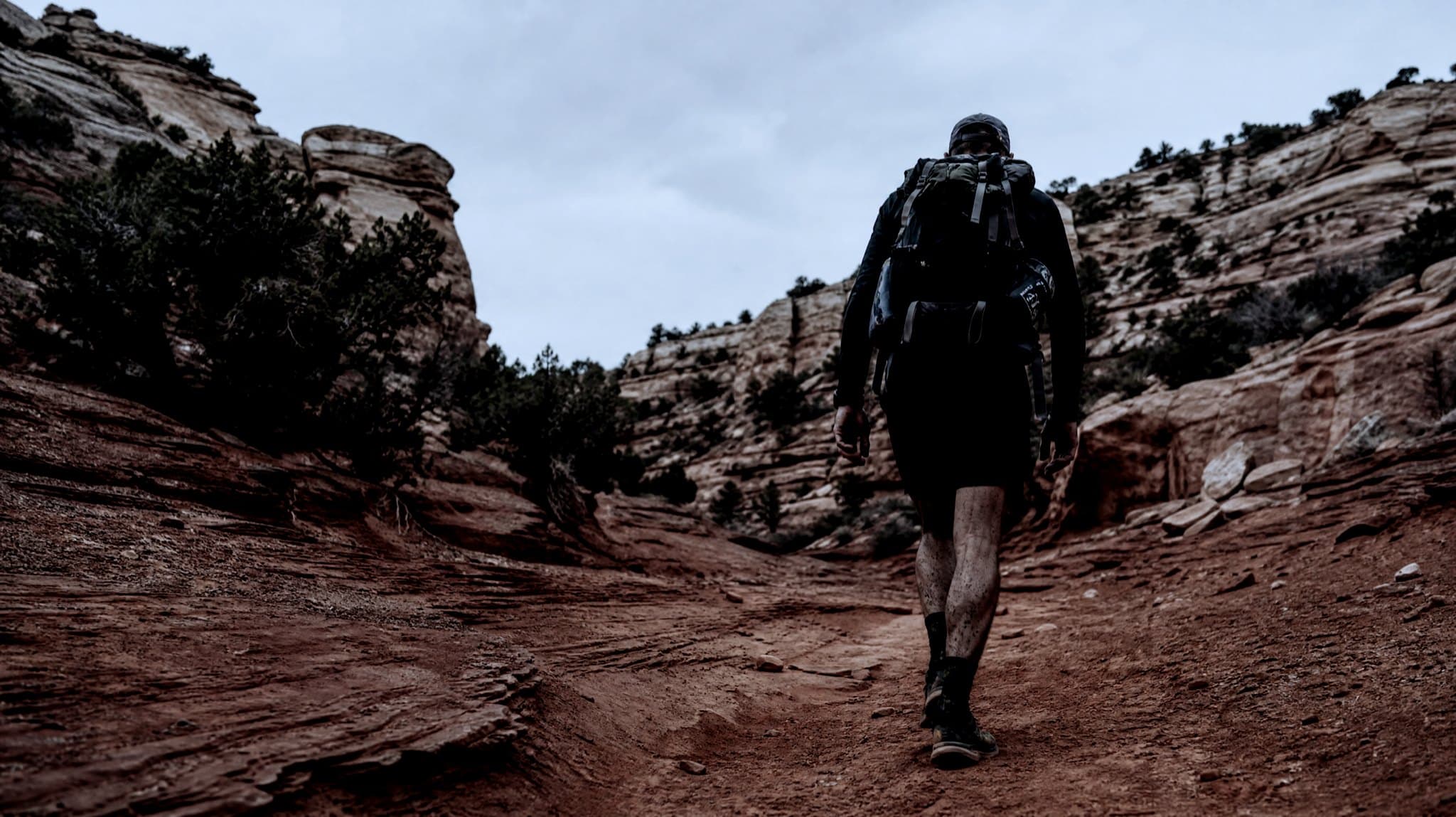
The Grand to Grand Ultra is 275 kilometres in six stages over seven days, through Arizona and Utah. The ground is red-rock climbs, slickrock, a slot canyon, forest trail and the Coral Pink Sand Dunes, and about half the course is on sand or sandy track. You climb 5,207 metres and descend 4,724, on a course that ranges from about 1,524 to 2,652 metres above sea level. You carry the week on your back.
The Founders' Farewell Edition
The organiser bills 2027, 19 to 25 September, as "The Founders' Farewell Edition". Tess and Colin Geddes founded the race and direct it. Their words: "In 2027 we'll stand on the start line one final time as your Race Directors." That is all the organiser says. As a secondary note, Sarah Lavender Smith, a several-time finisher, wrote in July 2026 that it may be the last G2G unless a new race director takes it on. I am not adding to either.
The dates that shape a build: the balance of the US$4,300 fee is due on 19 May 2027, registration closes on 30 June, and the signed medical certificate is due between 15 June and 20 August. Entrants must be 21 or over.
Water by the litre
Water is rationed. You get 1.5 litres at the start and at each checkpoint, 4.5 litres at camp, and 6.75 at the long-stage camp. Days average about 27°C. Drinking to thirst still works, but inside a ration you need to know what your thirst asks for before you get there. So in the summer I measure sweat rate on warm long runs, by weight before and after, and practise carrying 1.5 litres and making it last. Sodium is matched to sweat, never used as a licence to drink more. The hydration note is the starting point.
Climbing with a week on your back
Over five thousand metres of climbing with a typical 8 to 11 kg pack is the training centre of this race. The organiser caps the pack at 12 kg excluding water. Uphill walking with that load, on steep ground, is a trainable skill, and the walking note is how I build it. Hips, calves and back carry the pack for seven days, so two strength sessions stay in the plan all year; the strength note has them. The course averages over 1,850 metres, high enough to make easy effort cost a little more. A few days early at altitude helps if you can manage it.
The nights matter too. They average about 8°C and, in the organiser's words, can drop dramatically. A 0°C sleeping bag and a down or fibre jacket are mandatory.
- Stage 1 · 49.6 km · 13 h
A long first day with the pack at its heaviest.
- Stage 2 · 43.3 km · 12 h
Another marathon-plus, on day one's legs.
- Stage 3 · 85.4 km · 34 h
Days three and four. 4,000 kcal of food for this stage alone, and 6.75 litres at the camp after it.
- Stage 4 · 41.9 km · 12 h
The day after the long one, with whatever sleep you managed.
- Stage 5 · 42.2 km · 12 h
A marathon on six days of accumulated fatigue.
- Stage 6 · 12.7 km · 2 to 4 h
Staggered starts to the finish.
Stage 3 is the race
In 2026, five of the eight runners who did not finish stopped on Stage 3. Runner reports from earlier editions show why. One back-of-pack runner in 2014 crawled up about twenty dunes in the dark after 40 miles, ran short of food with one gel left for the last 13 miles, and found running "virtually impossible" through the thorn scrub of Hell's Garden. I rehearse it once: an overnight loaded walk of 50 km or more, eating the stage's food plan by the clock, with the night routine from the night note. The next day tells me how it went.
Days four and five, after the long one
The two stages after Stage 3 each carry a 12-hour cut-off. That is the durability question for G2G: what a loaded marathon costs on legs that have just done 85 km. In training I set it up with a long overnight session followed by a loaded day, then compare uphill walking speed at the easy cap and heart rate on the same climb across both days. Heart rate with a pack on is a proxy, so I read it beside how the athlete says they feel. If day two falls apart, the watch shows that it happened, not why. Legs, food, sleep or water are all possible. Then I decide.
From entry to September
A September race gives a British summer to train in. I use 24 weeks from early April: eight of easy volume and strength, eight of loaded climbing, six built around Stage 3, and a two-week taper. Strength stays twice a week, never in the 48 hours before a loaded day. Four sessions do most of the work:
- Steep loaded climbs. From week 9, uphill walking with the pack on the steepest ground nearby, every 10 to 14 days. One change per step: 0.5 kg more, or about 10% more time. The target is your race pack of 8 to 11 kg, never over 30% of body weight.
- The ration run. Warm long runs carrying 1.5 litres between refills, weighed before and after to find your sweat rate. Carbohydrate rises 10 g an hour every one to two weeks from 30 g, reaching race rate two weeks out.
- The Stage 3 night. Around week 18, the overnight loaded walk of 50 km or more, with a loaded three-hour day after it. Carry full race weight on it only if you've already carried it on shorter days.
- The heat block. Ten to fourteen days of 60 minutes easy in the heat or hot baths after runs, ending two or three days before you fly, with top-ups twice a week after it.
The taper cuts volume by a quarter, then by half, and keeps every run. The heat note covers the block in detail.
What I check in a G2G build
- Uphill walking speed at the easy cap with 10 kg on the steepest ground nearby.
- Fluid used per hour on warm long runs, set against a 1.5 litre ration.
- The loaded day after the overnight rehearsal, against a fresh one.
- Whether 4,000 kcal goes down across a single long day.
- Warmth and sleep in the race bag and jacket on a cold night.
- Feet after sessions that mix sand and rock.
Facts checked October 2026 against g2gultra.com: the home, course, rules, equipment, FAQ, 2027 entry details and 2027 important dates pages, and the 2026 and 2025 overall results PDFs. Confirmed: 275 km over six stages in seven days, stages of 49.6, 43.3, 85.4, 41.9, 42.2 and 12.7 km with cut-offs of 13, 12, 34, 12, 12 and 2 to 4 hours, 5,207 m up and 4,724 m down, a 1,629 m start, 2,156 m finish and high point of about 2,652 m, rationed water as above, 14,000 kcal minimum, a pack of typically 8 to 11 kg with a 12 kg cap excluding water, a mandatory 0°C bag and insulated jacket, September averages of about 27°C and 8°C, the 2027 dates, fee and deadlines, and the "Founders' Farewell Edition" billing. The stage table carries no year. Finish rates (27 of 35 in 2026, 48 of 58 in 2025) and the Stage 3 drops are computed from the organiser's results. The note that 2027 may be the last G2G is secondary (Sarah Lavender Smith, July 2026). Runner experiences are reports, not facts. Evidence level: load carriage, hydration and heat physiology match the field notes; the overnight rehearsal is coaching practice, and so are the 24-week build, the pack steps, the fuelling ladder and the taper cuts. The 30% of body weight cap is a military guideline, not a trial result in runners.
Going for the farewell edition?
Tell me how you climb with a pack, what you drink on a warm long run and how far you have walked through a night.