
Race training · Desert and heat
Oman Desert Marathon training: 165 kilometres of Wahiba sand in January
Darren Ware, ultra running coach · updated · 7 minute read
- Distance
- 165 km · 5 stages · self-sufficient
- Dates (2027)
- Stages 10 to 14 January per the programme · home page says 9 to 13 January
- 2027 stage split
- Not confirmed: the organiser's pages conflict
- Past long stages
- 45 km night stage (2026) · 42 km stage 1 (2025)
- Food carried
- 3,000 kcal a day minimum, 15,000 in total
- Water · camp
- Checkpoints about every 10 km · tents provided
- Conditions
- Organiser: feels like 40°C, actually 26 to 28°C · nights 12 to 15°C
- Cut-offs
- Times not published · outside one is disqualification
- Entry
- US$1,575 early bird, $1,680 from 1 August (no year shown) · 18+ · ECG within 30 days of the race
The Oman Desert Marathon is 165 kilometres in five stages across the Wahiba Sands, in January. You carry your food and kit. The organisers hand out water at checkpoints about every 10 km and put up the tents. The field is small: about 30 multi-stage runners in 2025, and 28 classified 165 km finishers in 2026.
It is the same self-sufficient format as the MdS I ran in 2003, over five days instead of a week. For a first multi-stage that size helps. The sand does not get any easier for it.
What is confirmed for 2027, and what is not
The organiser's own pages disagree, so I will set out what each one says. The 2027 event programme puts the stages on 10 to 14 January, with arrival on the 9th. The home page says 9 to 13 January. The stage splits are worse. The home and About pages give 42, 32, 40, 30 and 21 km, which matches 2025. The Classic race page gives 40, 29, 30, 45 and 21 km, which matches 2026. Neither says 2027, so I am not printing a 2027 split.
What the organiser does confirm: 165 km, five stages, self-sufficient, a 3,000 kcal daily food minimum, and disqualification if you finish outside a cut-off. The cut-off times are not published. Nor are ascent or pack weight. If you enter, ask the organiser for the stage split before you plan the long day.
- 2023
Stage 2 was the long one: 55 km, from the organiser's blog.
- 2025
Stage 1 was the longest day at 42 km. The night stage was 30 km and, by one race report, opened with 6.8 km of dunes.
- 2026
Stage 4 was a 45 km night stage, started in waves from 15:00.
- 2027
Not confirmed. Until the organiser says otherwise, I plan for a long stage that runs into the dark.
Sand on tired legs
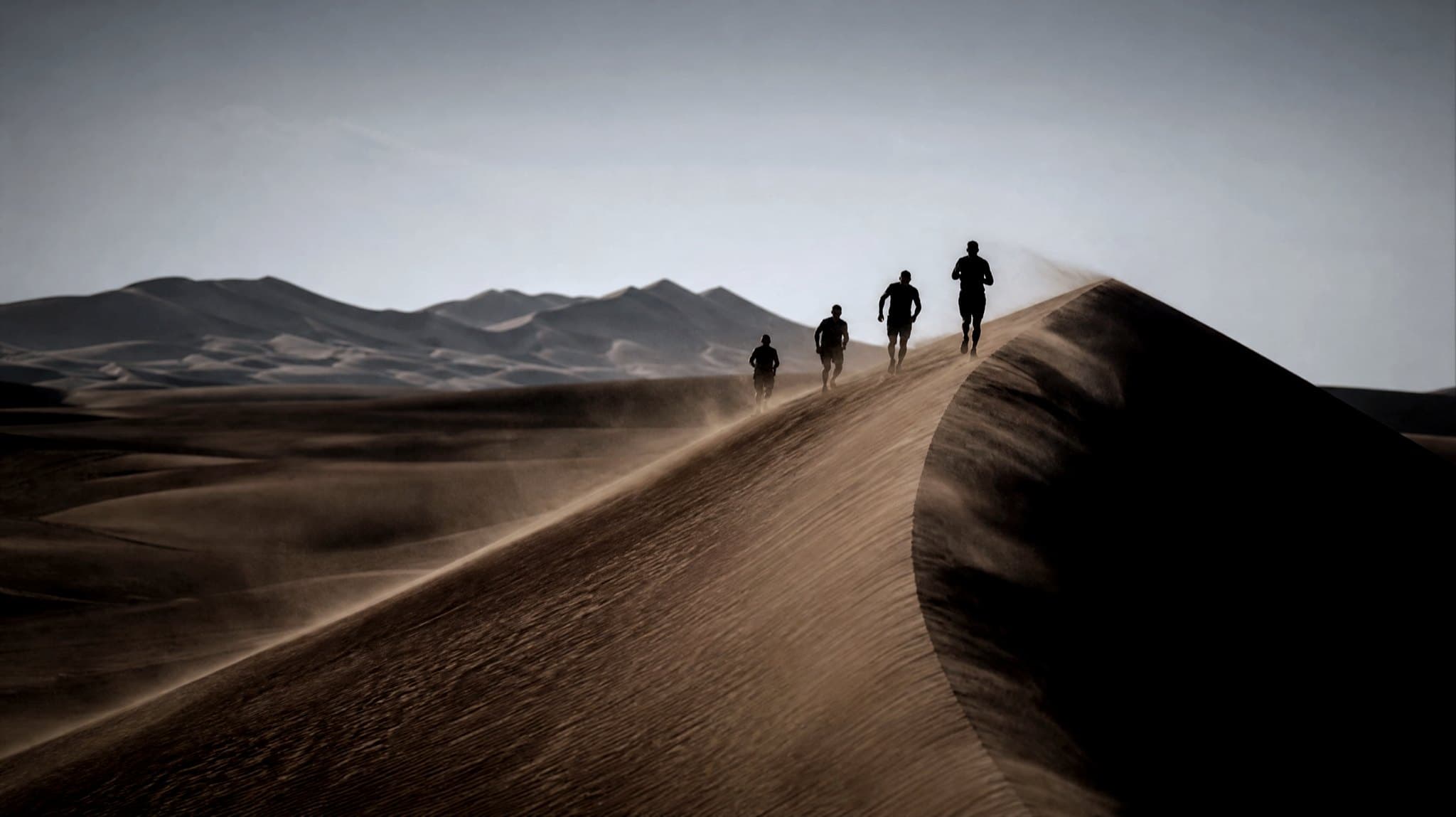
The Wahiba is dune and flat sand sea. One first-time desert runner called it the hardest thing he had ever done, and said nothing prepares you to run in sand. Every step slides back a little, and your calves and Achilles do the work a road would do for you.
The organiser's own report of day one in 2026 put the damage in the last 10 km of dunes, after the third checkpoint, on legs that already had 30 km in them. That order matters. A dune climbed fresh is a workout. The same dune at kilometre 30 decides your day.
So I put soft sand at the back of long sessions: a beach, a dune system if one is in reach, or a loose sandy track. Short and often beats one heroic weekend. Calves and Achilles get slow heavy calf raises twice a week from the start of the build, because over 40 those tendons take longer to adapt than the heart does. The strength note has the sessions. Sand gaiters are mandatory, and I want them on every sand session so the fitting is solved by Christmas.
An afternoon start that ends in the dark
The 2027 programme again starts stage 4 in waves between 15:00 and 17:00 and estimates the last runner in at 02:00. Those are estimates, not cut-offs. For a mid-pack runner it means eating a proper lunch, starting in the warmest part of the day, then finishing on sand by headtorch. A headlamp is on the mandatory list. I rehearse the whole sequence once: a midday meal, a 15:00 start, and three or four hours on loose ground into the dark. The night note covers lights and eating late.
Food, the bag and cool nights
Three thousand kilocalories a day is the floor, so food is most of the pack weight. Weigh it per thousand kilocalories and test every meal on consecutive days of training. The organiser gives nights of 12 to 15°C and limits the sleeping bag to 500 to 800 g. One 2017 finisher reports nights colder than his sleep kit could handle, and says he broke mentally in the soft dunes near the finish after poor sleep and short food. I test the bag on a cold night at home. The rest of the mandatory list is short: an anti-venom pump and 35 OMR in cash among it.
Where the dunes find you out
Pace on sand means very little, and grade-adjusted pace does not know the ground is soft. Heart rate is a proxy here, nudged by heat and pack as well as effort. So the durability read I trust in an Oman build is narrow: the heart-rate cost of the same sand loop late in a long session against early, and day two of a back-to-back weekend against day one. When the cost climbs, the watch cannot tell me whether it is calves, heat, food or sleep. I ask, then I decide whether the next block needs more sand, more strength or more rest.
Building for a January start
A January race means a British autumn build and a winter heat block. Capped easy volume and two strength sessions through the summer. Loaded walking from September, with the pack built up in small steps. Sand weekly from October. A back-to-back weekend every few weeks, one of them starting mid-afternoon. Then hot baths or sauna after easy runs in the last two to three weeks, ending a few days before the flight. The heat note has the protocol. The paperwork sits in the plan too: a medical certificate by 10 December 2026, and an ECG dated within 30 days of the race. Check with the organiser how they want those two lined up.
What I watch before the Wahiba
- Heart rate on the same soft-sand loop at the end of long sessions, against the same loop fresh.
- Calf and Achilles stiffness the morning after sand work.
- Food weight per thousand kilocalories as the pack list firms up.
- How the afternoon-start rehearsal went: lunch, the heat, the dark.
- Sleep and warmth on a cold-night test in the race bag.
- Easy-pace heart rate through the December heat block.
Facts checked October 2026 against omandesertmarathon.com: the home and About pages, the 165 km Classic page, the 2027 race rules, the 2027 event programme, the FAQs and the desert running tips page. Confirmed: 165 km over five self-sufficient stages, a 3,000 kcal daily minimum (15,000 total), water at checkpoints about every 10 km, tents provided, mandatory sand gaiters, anti-venom pump, headlamp and 35 OMR, a 500 to 800 g sleeping bag, nights of 12 to 15°C, disqualification outside a cut-off, and fees of US$1,575 and $1,680. The organiser's pages disagree on the 2027 dates and on the stage split, so no 2027 split is given; the fee page carries no year. Per-stage cut-off times, ascent and pack weight were not published. The 2026 night stage and 2023 long stage are from the organiser's pages and blog; the 2025 night-stage details are from a secondary race report, and the 2026 finisher count is from the organiser-linked results. Runner experiences are reports, not facts. Evidence level: heat acclimation and tendon loading match the field notes; sand-specific training is coaching practice.
Thinking about Oman?
Tell me what you have run on sand, how you sleep in a tent and what your calves think of soft ground.