
Race training · Desert and heat
Ultra X Jordan training: five days in Wadi Rum without carrying the week
Darren Ware, ultra running coach · updated · 7 minute read
- Distance
- 220 km · 5 stages over 5 days (2026)
- Stages
- About 38 / 40 / 60 / 48 / 34 km (event page)
- Ascent · descent
- 2,522 m each way · Stage 3 alone 883 m up, 895 m down
- Support
- Not self-supported · holdall moved between camps
- Food
- Your own: 2,000 kcal a day plus 800 kcal emergency
- Cut-offs
- 2.5 hours per 10 km · exact times given before each stage
- Conditions
- 26 to 34°C (event page) · nights 13 to 18°C (race pack)
- Completion
- 54 of 62 finished all five stages (2026, computed)
- Next edition
- 2027 dates and fee due when entry opens, 12 October 2026
- Entry (2026)
- £1,845 plus £34.57 booking fee · race insurance mandatory
The first thing to know about Ultra X Jordan is what you do not carry. It is not self-supported. You run each day with your safety kit, your food and your water for the stage. Everything else goes in a holdall that the organisers move between camps.
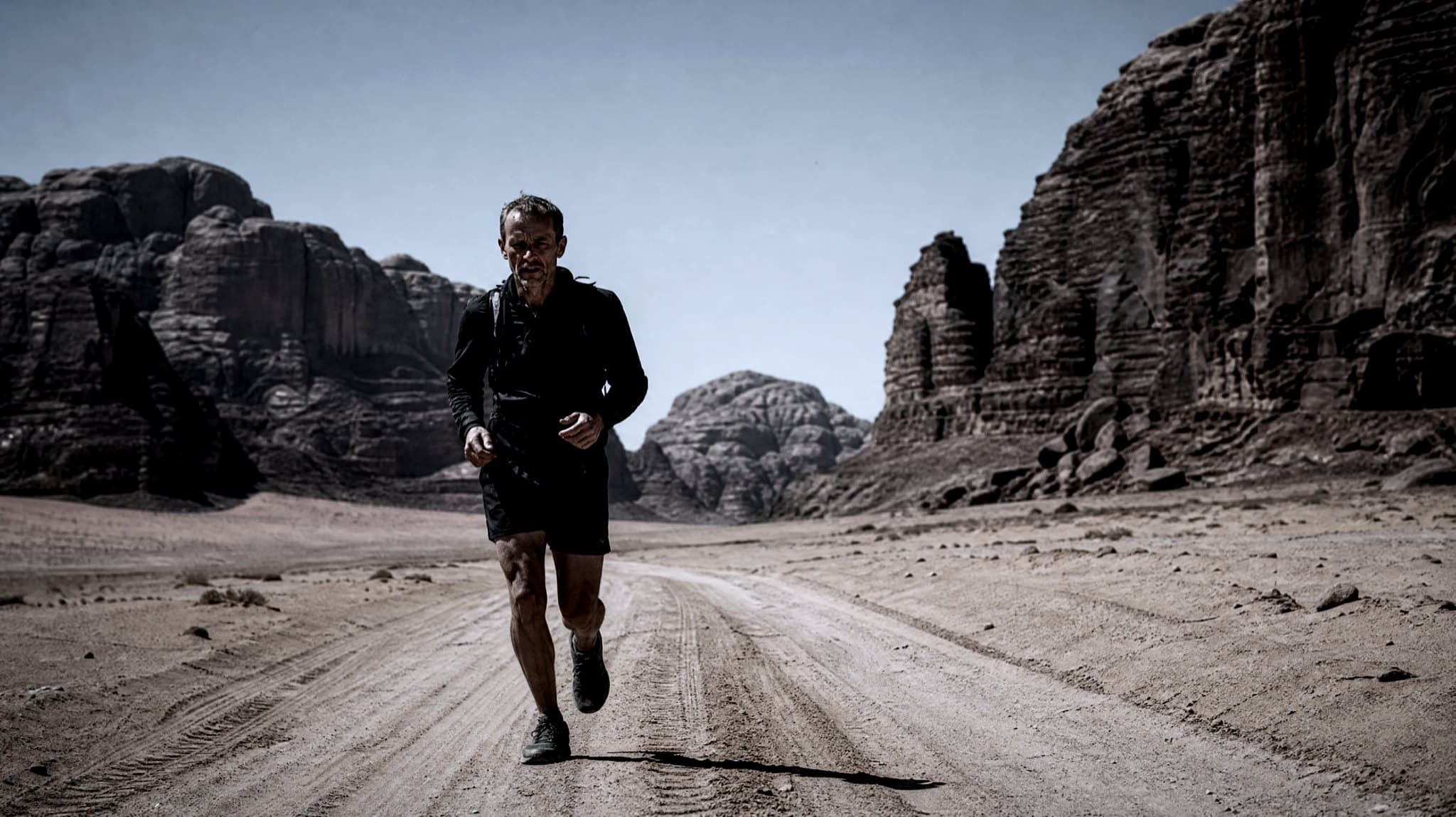
The race is five stages through Wadi Rum: 220 kilometres in the 2026 edition, with 2,522 metres of climbing and the same down. The ground is hard-packed sand, dry riverbeds, rocky canyons and soft dunes. The organiser rates its technicality at 2 out of 5. The 2026 race, the 10th anniversary edition, finished on 2 October. Entry for 2027 opens on 12 October 2026, and the 2027 dates and fee are due then.
Why a moved bag changes the plan
The holdall limit is 18 kg in the race pack and 20 kg in the kit list. You still bring your own food, at least 2,000 kcal a day plus 800 kcal for emergencies. Water comes at checkpoints, hot water in camp, and you share a tent with about ten others. You never carry the whole week's food and a sleeping system up a climb.
That makes it a different race from the Marathon des Sables. For the MdS I build loaded walking as the core session, because under a full pack on sand most of the field walks. In Jordan the daily pack is light, so more of the course can be run. The organiser's race pack says most runners run 30 to 60 per cent of it and walk the rest. So I keep some walking with a light pack, and I put the running back: run-walk on hard-packed ground at a controlled heart rate.
The risk I see is a runner who treats the light pack as permission to go out fast, with the heart rate climbing as the day warms. The heart-rate note is the discipline I teach for that. The same cap that keeps an easy run easy at home keeps day one from costing day four.
Five hot days in a row
The event page gives 26 to 34°C. The race pack gives an average of about 28°C, a range of 15 to 35°C, and nights of 13 to 18°C. In the organiser's 2022 report, a day-one high of 37°C took out more runners than usual. Heat here comes on top of five straight days with no rest day. A heat block in the two to three weeks before travel, from the heat note, is still the biggest single lever. The race pack also says the vast majority of dropouts come from neglecting feet and hydration. That is organiser guidance, not a statistic, and I plan around it. The hydration note covers drinking to thirst with sodium matched to sweat.
The 60 kilometre day, then the canyons
Stage 3 is the long one: about 60 km, with 883 metres up and 895 down. It starts at 04:00, and slower runners are offered earlier starts. At 2.5 hours per 10 km, the cut-off pace works out at about 15 hours for the stage. The organiser's 2022 report, on an older, longer format, called the long stage "the mother of all struggles", with some runners on their feet for 17 hours. Stage 4 follows at about 48 km, through what the organiser calls thin, technical canyons. I want one training weekend that copies the order: a long early start, then a technical day on tired legs.
Feet, when the habits fade
A medic who worked the 2024 race watched the blister clinic grow every day. She saw self-care habits fade as fatigue took hold late in the week. I train that part. A foot routine done every evening of a training block, including the last evening, when you least want to do it. Shoes tested on hard pack, rock and soft sand. One desert runner advised more cushioning and a rubber outsole for the rocks. I treat that as a starting point to test, not a rule.
Day four on runnable ground
Because more of Jordan is runnable, the watch data from a build is more useful than in a pure sand race. On hard-packed trail, pace at the same heart rate in the second half of a long run against the first is a fair durability read. So is the run-walk ratio on day three of a block against day one. On soft sand those numbers lose meaning, and grade-adjusted pace cannot account for the surface. When the second half slows, the watch shows that it slowed, not why. Heat, legs, food or sleep are all possible. I ask, then I decide whether the next block needs more heat, more running volume or more rest.
Building around a lighter pack
Five days averaging about 44 km is closer to a running week than a carrying week. I build it inside a normal seven-day structure. Capped easy volume and two strength sessions through the base. Then a specific block of back-to-back run-walk weekends on hard ground, with the daily race vest. One three-day block with an early start on the middle day. Hill work for the climbs. The heat block, ending days before travel, then a taper. If you are entering for 2027, check the dates on 12 October before you count the weeks back.
What I look for in a Jordan block
- Pace at the easy cap on hard-packed trail in the second half of long runs, against the first half.
- The run-walk ratio on day three of a block, against day one.
- Whether day one of a block was run too fast, from the heart rate in its first hour.
- Easy-pace heart rate through the heat block, and the drop that says it is taking.
- Fluid and sodium per hour on hot runs, and weight change across them.
- Whether the foot routine still happens on the last evening of a block.
Facts checked October 2026 against ultra-x.co: the Jordan event page, the 2026 race information pack, the mandatory kit list and the 2027 register-interest page, with the 2026 fee from the organiser's booking platform. Confirmed: 220 km over five stages in five days in 2026, a 110 km Jordan Challenge added that year, 2,522 m of ascent and descent, a 60 km Stage 3 starting at 04:00 with 883 m up and 895 m down, cut-offs of 2.5 hours per 10 km, not self-supported with a holdall moved between camps, your own food at 2,000 kcal a day plus 800 kcal emergency, shared tents of about ten, 26 to 34°C on the event page, a technicality rating of 2 out of 5, race insurance mandatory and a 2026 fee of £1,845 plus £34.57. The organiser's own documents disagree on the stage splits (the page uses the event page and says "about"), the holdall limit (18 or 20 kg) and temperatures (26 to 34°C or 15 to 35°C). The race was about 250 km in earlier editions. 2027 dates and fee were not published; entry opens 12 October 2026, so re-check then. The 2026 completion figure is computed from the organiser-linked results. Runner and medic experiences are reports, not facts. Evidence level: heat and pacing physiology match the field notes; the training-week comparison is coaching practice.
Looking at Jordan for 2027?
Tell me how much of a long run you can hold at an easy heart rate, and how your feet cope with five days in a row.