
Race training · Mountain and technical
CCC training: Courmayeur to Chamonix as the rehearsal for UTMB
Darren Ware, ultra running coach · updated · 8 minute read
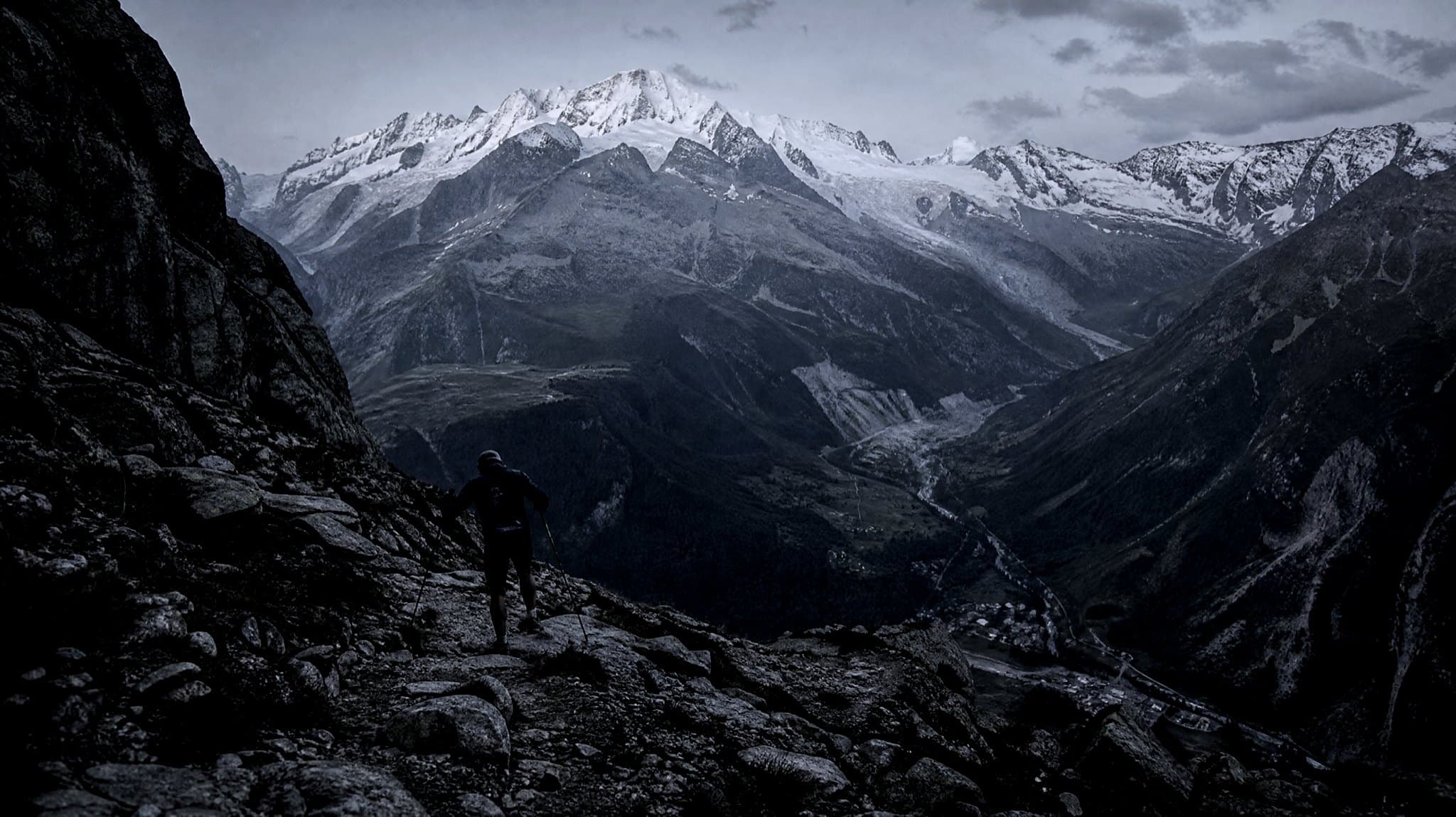
- Distance
- About 101 km, standard route · 108 km in 2026 (rerouted)
- Ascent · descent
- About 6,015 m up · 6,199 m down (standard) · 6,200 m+ in 2026
- Route
- Courmayeur to Chamonix, through Switzerland
- High point
- 2,556 m (course data) · Grand Col Ferret 2,527 m
- Time limit
- 28 hours in 2026 · 09:00 Friday start
- Crew
- One person, at certain aid stations
- Finish rate
- 76.8% (2026), 77.2% (2025)
- Next edition
- 2027 date not yet published
- Entry
- Lottery · UTMB Index (50K, 100K or 100M) + 1 Running Stone · €310 (2026)
The CCC leaves Courmayeur on a Friday morning, crosses the Grand Col Ferret into Switzerland, runs down through La Fouly, Champex-Lac and Trient, and finishes in Chamonix. On its standard route that is about 101 km, with about 6,015 m of climbing and 6,199 m of descent. The 108 km and 6,200 m+ you may have seen describe the rerouted 2026 edition. In 2026 the gun went at 09:00 and the limit was 28 hours. About three in four starters finished in both 2025 and 2026.
Most runners I coach for the CCC are not treating it as the goal. They want the full loop, and the CCC is the step before UTMB. I build it that way, as a race in its own right and as the best test you can buy of how your legs will behave on the bigger one.
A rung on the Mont-Blanc ladder
Entry is a lottery. In 2026 you needed a valid UTMB Index in the 50K, 100K or 100M category and at least one Running Stone earned in the two years before the lottery closed. A 100K-category finish earns three stones at a World Series event and six at a Major. Stones add up, never expire, and each one is another chance in the draw. A top-three finish in the 100K category at a World Series event gets you in directly. The 2027 rules and fee were not published when I checked.
If your longest mountain race is a 50 km, OCC is the gentler first step. In 2026 it ran 60 km and 3,500 m+ from Orsières to Chamonix with a 14 h 30 limit, and it accepts an Index in any category. OCC, then CCC, then UTMB is the order I would plan for someone new to the Alps.
The race turns at Champex-Lac
Runners report that the first half feels manageable. Then comes Champex-Lac at about 55 km, and race reports keep pointing at what follows: the Bovine climb, the steep climb out of Trient, the last pull to La Flégère. A top-ten runner in 2024 wrote that his climbing legs went on Bovine and his quads cramped. On the final climb his coordination went too: "My mind was foggy and I was tripping over myself."
So I train the CCC back to front. Long mountain days put the steepest climb in the last third, not the first. Three-climb sessions finish with the hardest one. I want legs that still climb with 50 km already in them.
One night, two headtorches
A 09:00 start still puts the back of the field in the dark. On the organiser's course data from the 2022 edition, the last runners had to leave Champex-Lac by 23:15, Trient by 04:00 and Vallorcine by 07:15. Those are past cut-offs, so re-check them for 2027, but the shape holds: anyone chasing the limit meets the deciding climbs at night.
The kit list asks for two working headtorches, each with backup power, a warm second layer and a hooded waterproof. In 2026 the organiser recommended a 20,000 Schmerber jacket with an RET under 13. The organiser warns that August can top 30°C and that runners have met -10°C above 2,000 m. An extra weather list can be switched on up to 24 hours before the start, and you must bring it to the event either way. One 2025 finisher reports night rain, a muddy descent near Vallorcine at around 20 min/km, and by hour 16 he "couldn't find a good spot for the next step." The night note covers how I rehearse the dark on tired legs.
Reading a CCC as a UTMB test
After the race I compare the second half with the first: time from Champex-Lac to the finish against the first 55 km, and climb rates on Bovine and out of Trient against the first climb to Bertone. If the climbs fell away, the engine was probably fine and the legs or the fuelling were not. I can only infer that: the watch shows the drop, never its cause. Grade-adjusted pace on steep, wet, technical ground is a rough number, so I compare like with like and lean on what the athlete tells me. A rerouted year, like 2026, is not comparable with a standard one.
One runner who did both races said the CCC left him much less beaten up than UTMB, and that recovery and the taper were his big lessons. The CCC is short enough to recover from and race again the next year, which makes it a good place to get the taper wrong once.
Building to Courmayeur
For a late-summer start, the plan runs from a winter of capped easy running and two strength sessions into a spring of long hill days. Long runs grow by the 110 per cent rule. Descents start early and build steadily, using the descents note. From June the long days carry their hardest climb late, and one includes a section after dark. One crew member can meet you at certain aid stations with a bag of up to 30 litres, so you need not carry the whole fuelling plan in your pack. Heat sessions go in if the British summer is cool.
What I watch, before and after
- Climbing speed on the last big climb of long mountain days, against the first.
- Whether foot placement holds on the final descent of a long day, or gets clumsy.
- How the athlete handles a long day that runs past dark, with the race torches.
- After the race: Champex-Lac to the finish against the first 55 km.
- After the race: how many days the legs take to come back, which shapes the UTMB plan.
- Running Stones and Index category, so the UTMB lottery entry is planned, not hoped for.
Facts checked October 2026 against montblanc.utmb.world and utmb.world: the standard route of about 101 km with 6,015 m of ascent and 6,199 m of descent from the organiser's course data, the 2026 reroute to 108 km and 6,200 m+, a 28-hour limit and 09:00 start in 2026, a 2,556 m high point, the 2026 entry rules (UTMB Index in the 50K, 100K or 100M category plus one Running Stone, €310), Running Stone values, one crew member with a 30-litre bag, the 2026 mandatory kit and weather warnings, and OCC's 2026 figures. Finish rates of 76.8% (2026) and 77.2% (2025) are counted from the UTMB Index result lists. The intermediate cut-offs are from the organiser's course data for the 2022 edition; the same data gives a 27-hour limit, and I could not confirm whether 28 hours is the new standard. The 2027 date, cut-offs and lottery rules were not published. Quotes and splits from runners are their own race reports. Evidence level: the eccentric loading and late-race fatigue physiology matches the field notes; using the CCC as a UTMB test is coaching practice.
Using the CCC to get to UTMB?
Tell me your longest mountain race and what happened to your legs in the second half.