
Race training · Mountain and technical
Eryri 100M training: Ultra-Trail Snowdonia's 100-miler under its new name
Darren Ware, ultra running coach · updated · 8 minute read
- Distance
- 163 km / 101 miles, loop from Llanberis (2027 listing)
- Ascent
- 9,200 m (organiser; its course data sums to 9,027 m)
- Time limit
- 48 hours · 14:00 Friday start · cut-offs at each aid station
- Terrain
- Exposed ridges, scree, boulders, boggy moorland
- Support
- No pacers · one personal assistant at certain aid stations
- Navigation
- Waymarked · night navigation skill expected
- Finish rate
- 40% (2026, 112 of 280)
- Next edition
- Friday 14 May 2027 (event 14 to 16 May)
- Entry
- UTMB Index in 100K or 100M (380+ recommended) · 4 Running Stones
Until 2026 this race was Ultra-Trail Snowdonia. For 2027 the organiser has renamed the event Eryri by UTMB, and the 100-mile race is now the Eryri 100M. Old pages under the Snowdonia name still turn up in search. The route changes from year to year as well. In 2025 it measured 169.7 km with 9,660 m of climbing; the 2026 and 2027 listings give 163 km and 9,200 m; third-party sites quote other figures from older editions. Check which edition anything you read describes. This page describes the 2027 listing.
The loop starts and finishes in Llanberis and crosses Yr Wyddfa, the Glyderau, the Carneddau, Moel Siabod, the Moelwynion, Cnicht, Moel Hebog, the Nantlle ridge and Moel Eilio. You start at 14:00 on a Friday and have 48 hours, so most finishers spend two nights out. In 2026, 112 of 280 finished.
Nine thousand metres of Welsh rock
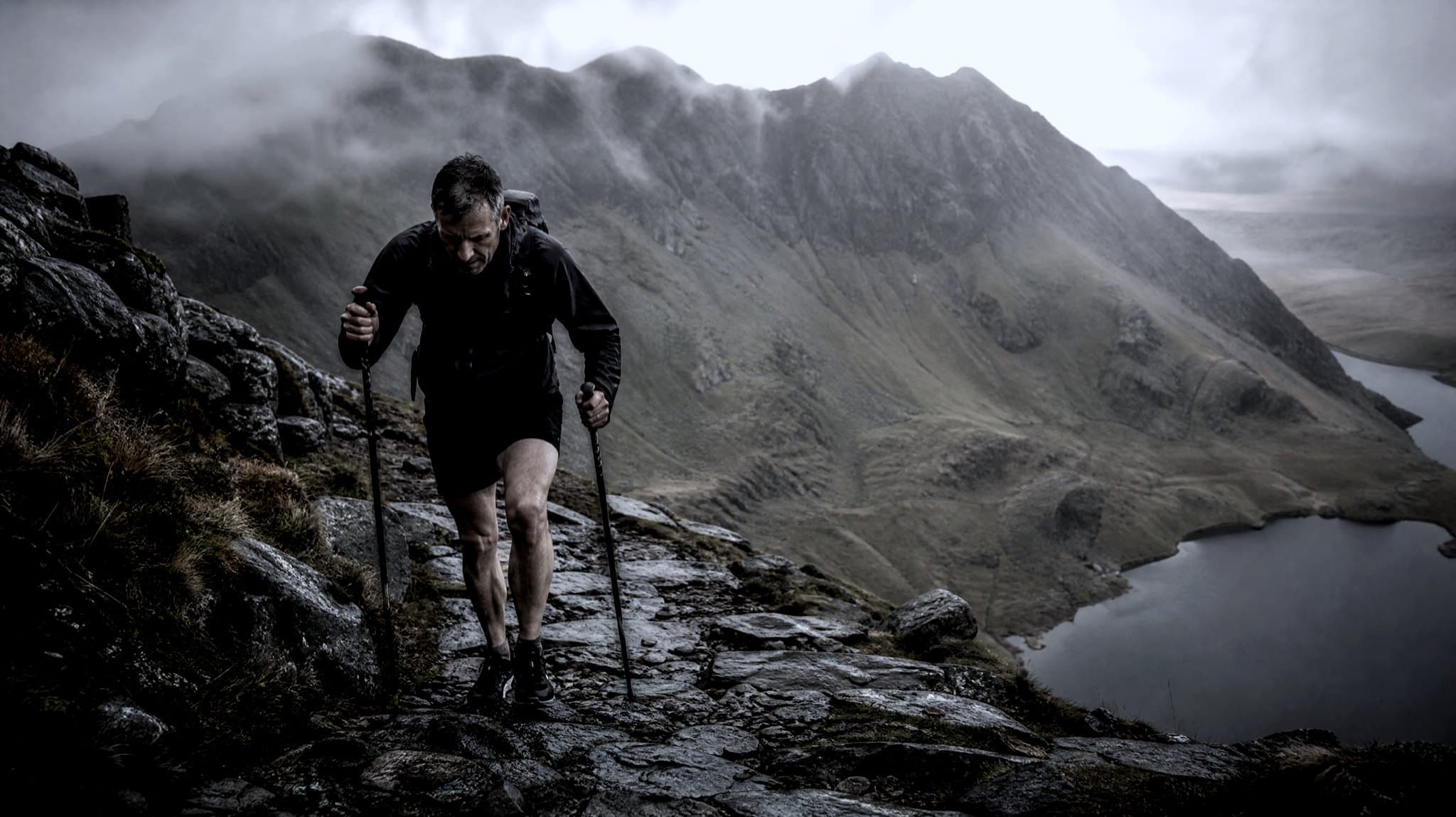
The organiser describes technical trails, exposed ridges, rocky scree, boulder-strewn paths and boggy moorland. You will walk much of that. On this ground the race turns on how fast you move uphill with kit and how well you descend on rock when tired. Three single climbs approach 900 metres each.
Yr Wyddfa twice, the second time in the dark
On the 2026 cut-offs the back of the field leaves Rhyd Ddu by 02:00 on Sunday, climbs 877 metres back to the summit and drops 920 to Bron-y-Fedw Uchaf by 06:45. That descent comes after 130 km, on the second night, on rock. One coach and two-time finisher reports Beddgelert, at 112 km, as a big drop point, with a long, steep, technical climb and no easy water to follow. A 2025 finisher described the second night as "a blur of sleepiness and grind", managed with five to ten minute naps. I rehearse that: one overnight session in the hills before May, with a caffeine and nap plan from the night note.
The entry asks for proof
The organiser says this is not a race for Ultra-Trail novices. It asks for an 80 km run with at least 50 m of climbing per kilometre, and for the ability to hold 4.5 km/h up to 80 km and 3.5 km/h beyond. It names the Bob Graham, Paddy Buckley and Ramsay rounds, the Lakeland 100, the Arc of Attrition and TDS as the kind of experience it means. You need a UTMB Index in 100K or 100M, with 380 or more recommended. Registration for 2027 was "opening soon" when I checked, with no date given.
I use the organiser's speeds as training benchmarks. They are heuristics, but they are the race's own. On a long hill day with 50 m of climbing per kilometre, are you still moving at 4.5 km/h after six hours?
Descents the watch can't grade
A coach and two-time finisher saw many runners on the descents before Capel Curig, the first 50 km, "moving tentatively and inefficiently". The same report calls Cnicht and its bog the place where foot problems often begin. On scree and bog, grade-adjusted pace is a poor proxy, and I tell athletes not to trust it. So I compare like with like: the same rocky descent timed fresh and again late in a long day, plus the athlete's own report of how the legs and feet felt. If the late time falls away, the possible contributors are the quads, the feet, confidence on rock or fuel. The watch shows the slowdown, never the cause. The descents note covers how I build the legs for it.
A winter in the hills for a May start
From November: two strength sessions a week with heavy, slow lowering work, and loaded uphill walking from the hiking note. From February: long weekend days in Eryri or the Lakes, back-to-back where possible, with the full safety kit carried. Missing any of water, a hooded waterproof, a torch, a survival blanket or a phone means disqualification, and the list also includes waterproof trousers, gloves and a warm layer. Night navigation on ridges, because the organiser expects it. Sun protection too: a 2025 finisher was sick and cramping for hours after an evening in the sun on the Carneddau. Your assistant can hand over a bag of up to 30 litres at certain aid stations, and Croesor at 85 km holds a drop bag. The organiser may change the course or cut-offs for weather, so plan for both.
Numbers I check before Llanberis
- Moving speed on long hill days against the organiser's 4.5 and 3.5 km/h benchmarks.
- Time on a known steep rocky descent, fresh against late in the day.
- Climbing rate on 800 to 900 metre climbs, because the course has three.
- Feet after long days on bog and wet rock.
- Navigation accuracy and decision speed on night sessions on the ridges.
- Recovery in the three days after a big mountain weekend.
Facts checked October 2026 against eryri.utmb.world: the home page (the rename and 2027 dates), the Eryri 100M race page and its course data (the 2026 GPX, aid-station distances, per-leg climbing and descent, 2026 cut-offs), the required-experience page and the regulations. 163 km, 9,200 m on the organiser's banner (the course data sums to +9,027 m and -9,023 m), a 14:00 Friday start and 48-hour limit, cut-offs at each aid station (the 2027 page still shows 2026 cut-offs), no accompaniment outside spectator zones, one assistant with a bag of up to 30 litres, waymarking, the experience and UTMB Index requirements, and the safety kit rules. Finish counts are mine, from the organiser group's results on utmb.world: 112 of 280 in 2026, and 146 of 240 (61%) in 2025 on the longer 169.7 km course. Runner experiences of the descents, Cnicht, Beddgelert, the sun and the second night come from published race reports and are colour, not data. Evidence level: descent and sleep physiology matches the field notes; the training benchmarks are the organiser's, and the build is coaching practice.
Aiming at Eryri?
Tell me your longest mountain day, your UTMB Index and how your descending holds up after dark.