
Race training · Multi-day and extreme duration
Grand Union Canal Race training: 145 miles of towpath from Birmingham to London
Darren Ware, ultra running coach · updated · 9 minute read
- Distance
- 145.4 miles / 234 km, Gas Street Basin to Little Venice
- Ascent
- About 2,000 to 3,159 ft (the organiser gives both)
- Surface
- Towpath: gravel, tarmac, mud
- Time limit
- 45 hours · 06:00 Saturday start
- Checkpoints
- Nine, 10 to 21 miles apart · 40-minute stop limit
- Medical cover
- None on course
- Finish rate
- 45% (2026), about 49% (2025)
- Next edition
- May 2027, date not yet published
- Entry
- Draw, 100 places · no qualifier · £75 supported, £115 unsupported
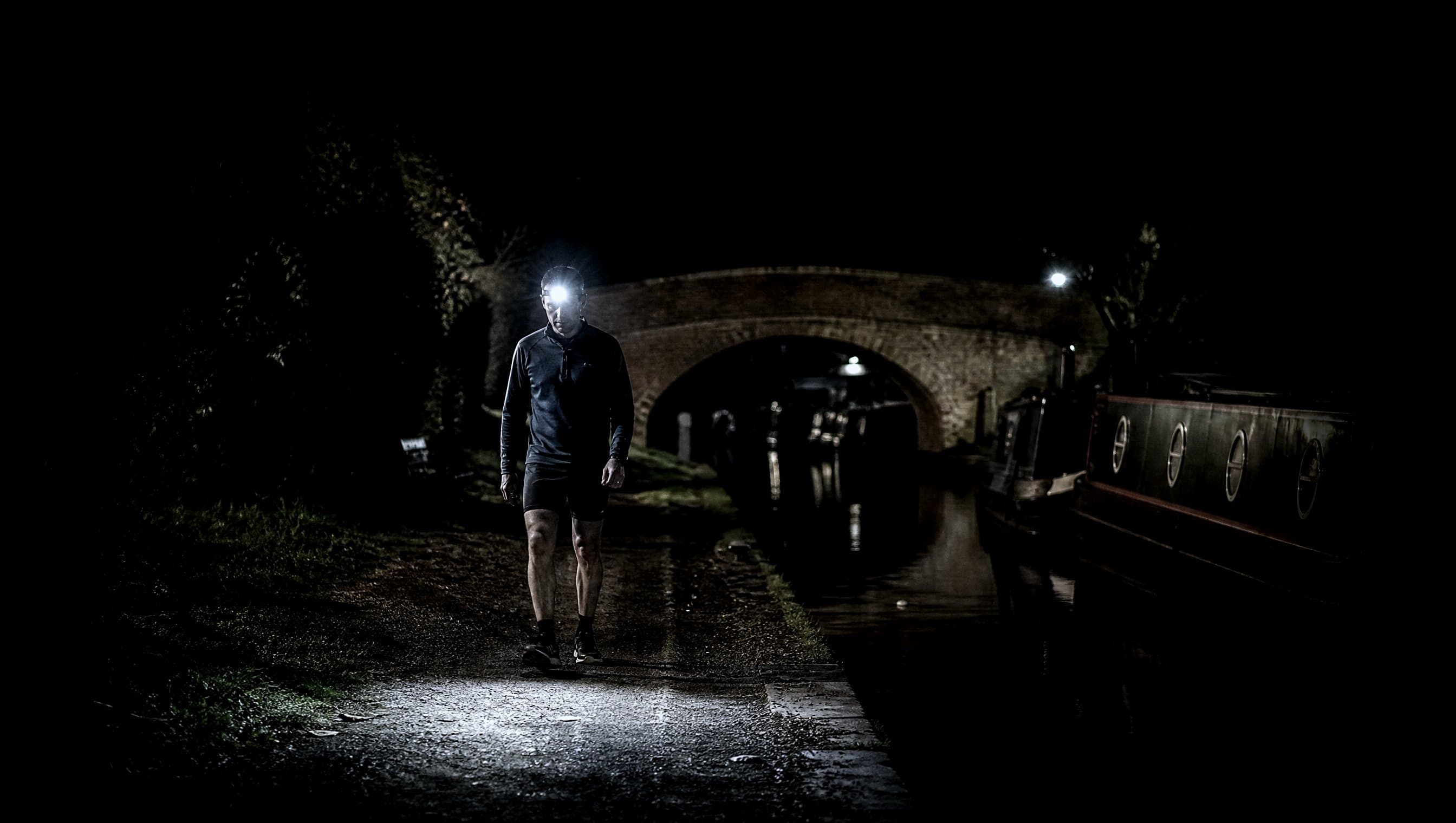
The Grand Union Canal Race starts at six on a Saturday morning in late May at Gas Street Basin in Birmingham and follows the towpath 145 miles to Little Venice in London. There are nine checkpoints, between ten and twenty-one miles apart, and you may stop at each for no more than forty minutes. There is no medical cover on the course, and the organisers say so. The limit is 45 hours. In 2026, the hottest edition on record, 39 of 86 starters finished. It is the hardest race in the library to finish and one of the cheapest to enter.
For a runner over 40 it is a hundred-mile race with a second day attached, on ground that never changes, at a price the field can enter on a whim. The whim is the problem.
Flat, for 40 hours
A mid-pack GUCR is 36 to 45 hours. One full night for everybody, a second night for the back of the field. On the towpath every stride is the same stride, and the calves, shins and feet take every one; road shoes are the organisers' recommendation. Long flat runs on hard ground through the spring, back-to-back weekends and calf and hip strength through the winter are the preparation. The durability question is the plain one from the legs note: whether you can still run when nothing about the ground has asked you to change.
- Hatton Locks, 22 mi, 12:00 Sat
Hot food and the first drop bag. The canal climbs the flight; you climb the steps.
- Weedon, 53 mi, 20:15 Sat
Second drop bag. Buddy runners can join. Dark soon after.
- Cosgrove, 71 mi, 02:00 Sun
The middle of the first night.
- Tring, 99 mi, 12:00 Sun
A hundred miles in 30 hours, with 45 still to run. The exposed Chilterns summit pound.
- Springwell Lock, 120 mi, 19:00 Sun
Second evening. The back of the field goes into a second night here.
- Little Venice, 145 mi, 03:00 Mon
45 hours.
Checkpoint 5, after dark
The organiser doesn't publish where runners retire, and its 2026 results post is no longer online. So the evidence is runners' own reports, and they point at the same place: checkpoint 5, around mile 70, called Navigation Bridge in older editions and Cosgrove Village Hall now. It is just short of halfway. For most of the field it arrives after dark, with 74 miles of the same towpath still to come. A 2016 finisher put it plainly: "It’s really desirable to hit Navigation Bridge in the light, as this point has historically proven a magnet for retirees."
The late miles bite even at the front: the 2022 runner-up called the four miles after 104 "pure purgatory". So I plan the first 70 miles to arrive at Cosgrove with something left, and the athlete leaves that checkpoint with a plan for the next three hours already written.
Twenty-one miles between aid
The gaps are what separate the GUCR from a hundred. You carry two hours of food and a litre of water out of every checkpoint, and you eat from your pack on a schedule, because the next hot meal is five hours away. The forty-minute stop limit is enforced; a supported runner's crew waits at the checkpoints with the car, an unsupported runner relies on the drop bags. Both rehearse the rhythm on training runs: leave with food, eat by the clock, arrive with the pack empty.
Heat with no shade, and the water
The towpath has no shade and 2026 was the hottest edition ever run. The heat note is the block in the fortnight before, and hydration is to thirst. The organisers' terms warn about leptospirosis from canal water, cellulitis and giant hogweed, and about the cyclists who share the path. None of that is training. All of it is why the plan says do not fall in.
Sleep
The race allows no sleep provision and the stop limit makes a real sleep impossible, so the second night is run on whatever you banked beforehand. The night note covers the block and the sleep extension in the fortnight before. An overnight rehearsal on the towpath, with a crew, is the closest a training run gets.
Where durability shows up
The towpath gives clean data, and the reads through a GUCR build are the flat-ground ones: the second half of long runs against the first at the same heart rate, and the day-after cost on the calves and feet. Heart rate through the heat block tells me acclimation has taken. The pattern I want by May is a runner who can run the fifth hour of a flat run at the same cost as the second. Then I decide what the next block holds.
Twenty weeks of the same step
The draw is in the winter and the race is in late May, so I plan 20 weeks from early January. Working athletes will recognise the working-week note; the GUCR build fits inside it.
- January and February · base
Capped easy running and two strength sessions a week heavy on calves, shins and hips, kept 48 hours clear of the long run. The long run grows about 10 per cent at a time against the longest of the last 30 days.
- March · time on feet
Long flat runs on hard ground with a run/walk pattern set now and used from the first mile on race day. Food from the pack by the clock, the carbohydrate step going up about 10 grams an hour every week or two.
- April · the canal itself
Back-to-backs on the towpath, peaking about five weeks out at six hours and four the next day. One overnight run from the evening into the small hours, with the pack, the crew and the 40-minute stop limit enforced.
- May · heat and taper
Ten to fourteen days of hot baths or sauna after easy runs, ending two or three days before the race, inside a two-week taper with the sleep banked.
What I watch
- Pace at the same heart rate in hour five of flat long runs against hour two.
- Calf, shin and foot soreness after long hard-surface runs, across the build.
- Easy-pace heart rate through the heat block.
- Food from the pack by the clock on long runs, and the gut score.
- Sleep in the fortnight before, and how the overnight rehearsal went.
Facts checked September 2026 against canalrace.org.uk, the 2026 race manual and terms: 145.4 miles, ascent given as both about 2,000 ft and about 3,159 ft by the organiser, a 06:00 start and 45-hour limit with the cut-offs above, checkpoints 10 to 21 miles apart with a 40-minute stop limit, no medical cover, buddy runners on foot from mile 53 (the manual also says Cosgrove, which the organiser should confirm), a draw for 100 places with fees of £75 and £115, and 39 finishers from 86 starters in 2026. The 2027 date had not been published when this was checked. Where runners retire was checked in October 2026: the organiser publishes no breakdown and its 2026 results post was no longer online; the checkpoint 5 pattern comes from published race reports (the quotes are from a 2016 finisher and the 2022 runner-up) and is colour, not data. The checkpoint name and mileage are from the 2026 manual. The build's month blocks, long-run and carbohydrate steps, peak weekend, heat block and taper are coaching method translated to this race, not a tested protocol. Darkness hours are computed from sunrise and sunset data. Evidence level: the flat-ground durability, heat and sleep physiology matches the field notes; the demands are the race's own.
Drawn for the GUCR?
Tell me your longest continuous run and whether you have a crew.